Profile
Lipa city is located in the northeastern part of Batangas Province, around 78 kilometers away from Manila. It is bounded on the north by the town of Malvar, on the east by Quezon Province, on the south by Padre Garcia and Ibaan towns, and on the west by the town of Mataas Na Kahoy. With many roads traversing the city including the Southern Tagalog Access Road (STAR), the city's appeal to investors has greatly been enhanced. The city has an area of 229 square kilometers. Although classified as a first class city, there are many areas which are rural and devoted to agriculture. Farm products include rice, coconut, rootcrops, and vegetables.

Lipa City Hall
Tagalogs make up the majority of the population. Other cultural groups found in the city are Bicolanos, Ilocanos, and Cebuanos. Most of the residents are Roman Catholics. Other religions include Iglesia Ni Cristo, Protestantism, and Islam.
Shopping and leisure facilities found in the city include Robinson's Mall, SM, Mount Malarayat Golf and Country Club , Summit Point Golf and Country Club, and Grand Makulot Golf Club in Fernando Airbase
Business OpportunitiesAs a transportation hub, Lipa can be an ideal site for businesses wishing to tapped the markets of Batangas, Laguna, and Quezon. The city is also a convenient stopover for those travelling southward to the many beaches in the coastal areas of Batangas or those going eastward to Quezon and Bicol areas or those travelling from Mindoro, the Visayas, and Mindanao going to Metro Manila. Hence, tourism-related establishments are very much encouraged. The presence of malls and golf courses is testament to the city's livability and as an investment haven. The following are some businesses that can be considered:
- Mass housing projects
- medium-size commercial complexes
- hotels and resorts
- food establishments
- amusement park
- commercial poultry and hog raising
- production of dairy products
- food processing such as meat packing, curing, and canning
- coffee production and processing - the city was once a leading coffee producer
- production of high value commercial crops like malungay, mushroom, vegetables
- demonstration farms
- consumer chemicals such as detergents and personal care products
- essential oil and fragrances
- furniture and fixture
- electronics and electrical appliances
- automotive and parts
- technology-related ventures like business product outsourcing, graphic design, and software development
- final service
- San Sebastian Cathedral built in the Romesque tradition with circular dome
- San Sebastian Library of the Arts
- Carmelite Monastery - the site of a miraculous "shower of Petals"
- Casa de Segunda Katigbak on 198 calle Rizal - a heritage house
- Mount Malarayat
- Susong Dalaga Mountain
Photo Gallery
San Sebastian Cathedral

Administered by the Augustinians beginning April 30, 1605 (and until the end of the 19th century) under the name “Convent of San Sebastian in Comintang” the first church building was made of light materials. The present building of “serious architecture, proven solidity and great proportions” began its construction through the concerted efforts of Augustinians who administered the Parish of San Sebastian and the faithful people of Lipa : in 1779, Fray Ignacio Pallares, later on continued by Fray Manuel Galiana in 1787, and its spacious transept completed in 1865 by Fray Manuel Diez Gonzalez.
The church was totally completed from 1865 to 1894 during the administration of Fray Benito Varas to whom Lipeños attribute their religiosity. He was also responsible for the erection of the Catholic Cemetery in Antipolo and, without any aid from the state, the bridge at Sabang and the road that served as a national highway to Manila and Laguna.

On January 24, 1991, petals fell straight from the sky at the Carmel Monastery in Lipa, Batangas. It was one of the many miraculous showers of petals that occurred at the site.
But the miracle at Mt. Carmel in Lipa City goes beyond petal showers and can be traced back to decades earlier.
The Luz-Librea-Bautista Ancestral House

The patriarch of the Luz clan, Don Jose de San Miguel Luz (Capitan Municipal, 1866-1867), fondly called Capitan Ute,built the grandiose stone mansion for his daughter Maria Luz married to Leon Librea.
The house took ten years to build due to the length of time spent in drying the lumber, sawing the wood, and transporting it from Mindoro to Lipa. The posts and frames were of molave, narra for the flooring, and santol wood for the ceiling and partitions. As cement was not available then, the walls and columns were made from adobe, lime, and sand. The roof was of galvanized iron. Red tile roofing became unpopular as they tend to fall off. The ceiling was covered by a cloth painted with designs copied from famous European paintings.
By the end of 1881, the majestic structure, inspired by Babylonian architecture with the curved and extensive columns, was completed.
With the house’s completion, Don Jose ordered several furnishings from Europe: the lace curtains from Paris, two Austrian high length mirrors, pieces of Viennese furniture, local furniture from Atay, a well known Filipino wood carver, fine Chinese porcelains, and all glassware, silverwares, plates, crystals, and chandeliers from Germany. It had undergone refurbishment in 1917 with the addition of bedrooms and a bathroom.
During the Japanese occupation, 1941-1944 the house served as a Japanese Headquarter. With the coming of the Americans in 1945, it became a hospital.
Casa de Segunda
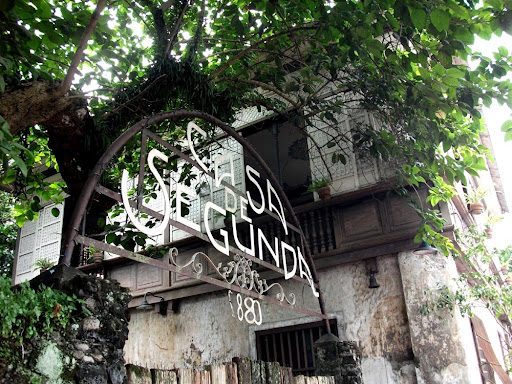
Partly damaged by the Second World War in 1942, the house was remodeled in 1956 by Segunda Katigbak’s daughter, Paz Luz Dimayuga. The grandchildren of Paz, who were born and raised here, restored the house in 1996 to its original form and grandeur, its fountain, fishponds, and orchards.
Casa de Segunda is named after Segunda Solis Katigbak who is known as the first love of Dr. Jose Rizal. To quote his biography, “His first infatuation was a little Lipeña by the name of Segunda. She was not the most beautiful woman I had ever seen but I have not met another more alluring and beguiling. I have already heard about her and that she was going to get married to a relative of hers. Indeed, I noticed a tall man neatly dressed who seemed to be her fiancé, thus, ended his first love which mourned in his journal.”
That tall man was Manuel Metra Luz who came from one of the most prominent families of Lipa (Katigbak, Luz, Roxas, Altamirano, Calao). The Luz Clan were a family of poets and scholars. Manuel married Segunda at the young age of 16 in 1879 and in that very house was blessed with nine equally bright and gifted children namely Cristeta, Manuel Jr., , Flora, Justa Ynes, Arsenio, Valeriano, Maria Paz, Julio, and Fernando.
These nine children had passed on these gifts and talents to their children and grandchildren. In cooperation with the National Historical Commission, Casa de Segunda, having been declared as a heritage house, is proud to honor these outstanding men and women who had contributed to the remnants of the past- be it in the cultural, historical, and the arts - “All echo the timeless qualities of Lipa reminding both residents and visitors alike that those olden days of prosperity need not be a distant memory
Bluroze Farms

Furthermore, the lushness of the place has enticed the Rodillo family to initiate planting fruit-bearing, medicinal plants and forest trees, flowering plants, vines and shrubs, which later on became some of the breath taking sites that Bluroze has to offer.
The Farm at San Benito

The Farm is a world class health resort that addresses every aspect of rejuvenation. A former coconut and coffee plantation located in the foothills of Mount Malarayat. The Farm is a 48 verdant hectares of gardens, ponds, mountains, rivers, lagoons and waterfalls. All 25 fully air conditioned accommodations –Sulu Terraces, Palmera Suites, Anahaw Villas, Garden Villas and the spectacular Master Villas. Spa and beauty treatments, along with spiritual development through meditation and yoga, makes this holistic resort an ideal place to relax and detoxify body and
Mount Malarayat Golf & Country Club

A total covered floor area of 3.9 hectares consists of the Clubhouse, Halfway house, Driving Range, Tea Houses, Rain Shelters, Country Clubhouse, Sports Lounge, Sports Facilities and the Children’s Center. It is only the golf course with a driving range contoured like a fairway.
